Abraham
Paradise LostAbraham appears in Michael's prophetic history as the faithful man chosen to become the human root of a providential nation and, ultimately, of the promised deliverer. His defining act is not conquest or inherited power but obedient trust: called away from his father's house and false gods, he leaves without knowing the land to which he is going, believing the promise that his seed will bless all nations.
Identity and Calling
Abraham is introduced as a patriarch living beyond the Euphrates and raised amid idolatry. God selects him from that setting and summons him by vision to abandon his kindred, his ancestral home, and the worship of idols for a land that God will show him. The call therefore begins with separation: Abraham must relinquish familiar religious and social securities before he can become the ancestor of a new people.
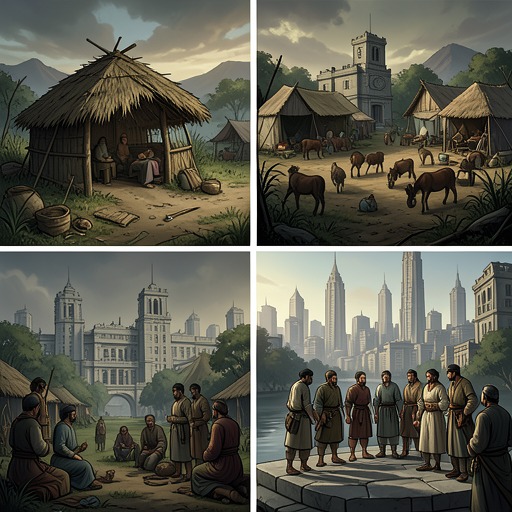
His response establishes the quality attached to his name. He obeys without knowing his destination, leaving Ur of the Chaldea and traveling toward Haran with a substantial train of herds, flocks, and servants. The journey is not represented as impoverished wandering. Abraham entrusts his wealth to the God who called him and enters an unknown country in confidence rather than relying on visible guarantees.
Journey and Promised Land
Abraham reaches Canaan and pitches his tents around Shechem and the neighboring plain of Moreb. There he receives the promise of the land for his descendants. Michael surveys its intended extent from Hamath in the north to the southern desert, and from Mount Hermon in the east to the western sea, naming Mount Carmel, the Jordan River, and the long ridge of Senir as landmarks within the promised inheritance.
The geography gives Abraham's obedience a historical and political consequence. His departure from Ur does not end in private spiritual consolation; it becomes the beginning of a people with a defined inheritance. The promised territory is attached to his progeny, while the larger promise extends beyond territory: through Abraham's seed, all nations of the Earth are to be blessed.
Descendants and National History
Abraham's line continues through a son and a grandson described as resembling him in faith, wisdom, and renown. The grandson's twelve sons lead the expanding family from Canaan into Egypt during a time of famine, where they settle at the invitation of a younger son who rises to become second in the realm of Pharaoh. The family grows into a nation, but its growth provokes suspicion; the Egyptians reduce the once-welcomed guests to slavery and order their infant males killed.
The history that proceeds from Abraham's seed includes deliverance through Moses and Aaron. God sends the two brothers to claim the enslaved people, and Pharaoh is compelled by signs and judgments: the rivers become blood, frogs, lice, and flies invade the land, livestock die, disease afflicts the people, hail and fire devastate the fields, locusts consume what remains, darkness covers Egypt for three days, and the firstborn die in a final midnight stroke. Pharaoh finally permits departure, but his renewed pursuit ends when the sea swallows him and his host while the rescued people pass between divided waters under Moses' rod.
This national history confirms that Abraham's significance is genealogical and theological at once. His descendants become the people through whom divine promises, law, judgment, guidance, and deliverance enter the unfolding story. Their failures do not erase the ancestral promise, though they repeatedly place the nation under judgment and bondage.
Relation to the Messiah
Michael identifies the promised seed of Abraham with the great deliverer who will bruise the Serpent's head. The promise therefore reaches beyond Abraham's immediate descendants and points toward the union of human and divine nature in the Son of God. In the later revelation, the Messiah's mother is a virgin, while his Father is the power of the Most High; through him, God joins himself to humanity.
The link between Abraham and the Messiah is presented as the decisive expansion of the patriarchal promise. Abraham's seed becomes the channel through which blessing reaches not only his biological descendants but also the sons of Abraham's faith throughout the world. Salvation is consequently no longer restricted to one ethnic lineage: all nations may share in the blessing promised through Abraham.
Faith and Narrative Significance
Abraham's narrative role is that of the faithful ancestor whose response to a summons gives history its direction. He does not control the future he enters, and the text emphasizes that he travels without knowing the land's destination. His faith is thus shown as action under conditions of incomplete knowledge: leaving, traveling, settling, and trusting the promise before its fulfillment is visible.
Within the book's political theology, Abraham also provides a contrast to the claims of self-originating power. Satan argues that created beings are self-begotten and that their own strength establishes their right; Abraham's story offers the opposite model. His importance comes through dependence on the God who calls him, and his promised greatness consists not in domination over other men but in becoming the source through whom blessing is extended to them.
Abraham therefore stands at the junction of obedience, migration, nationhood, and redemption. His departure from false gods initiates a covenantal history; his settlement in Canaan establishes the horizon of a promised people; his descendants carry that history through Egypt and deliverance; and his seed ultimately becomes the Messiah through whom the promise is opened to all nations.